Choosing the Right Wireless Protocol for Your IoT Device
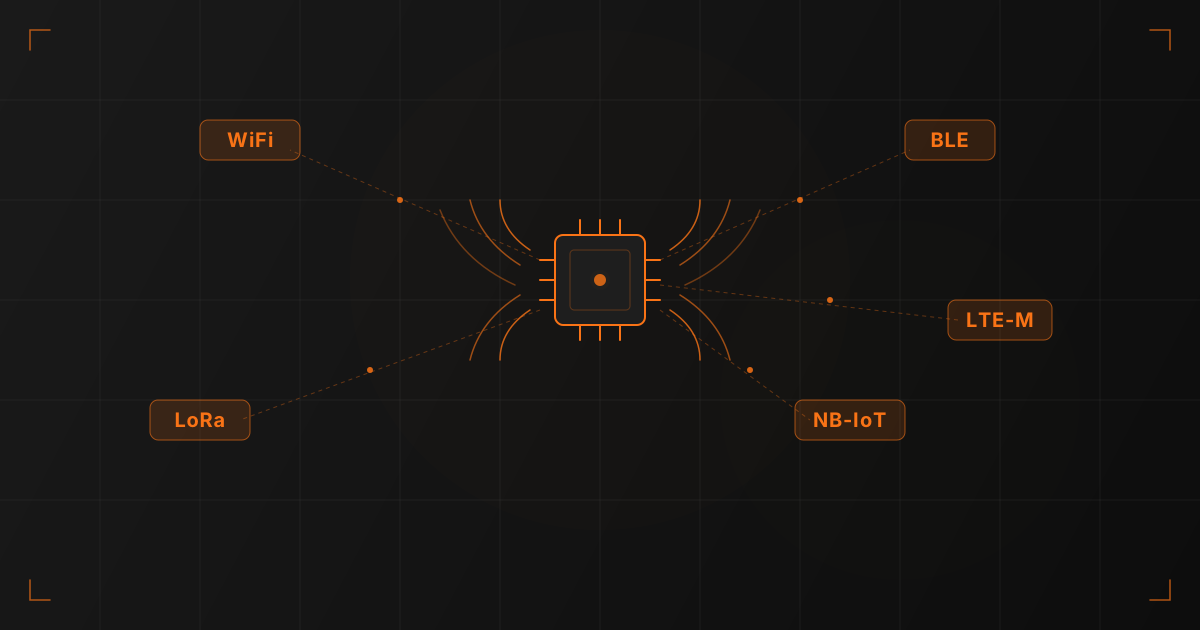
One of the earliest and most impactful decisions in IoT product design is choosing the wireless protocol. Get it right and everything flows — power budget, antenna design, cloud architecture. Get it wrong and you’re looking at a board respin six months in — typically $30–60K and 3–4 months of rework, because the protocol choice cascades into MCU selection, antenna layout, certification scope, and cloud architecture.
The Decision Matrix
There is no universal “best” protocol. Every choice is a trade-off between five dimensions:
| Factor | WiFi | BLE | LoRa | NB-IoT | LTE-M |
|---|---|---|---|---|---|
| Range (practical) | 50–100m | 30–100m | 5–15km | 10km+ | 10km+ |
| Power | High | Very Low | Very Low | Low | Medium |
| Data rate | 100+ Mbps | 2 Mbps | 50 kbps | 200 kbps | 1 Mbps |
| Latency | Low | Low | High | Medium | Low |
| Module cost | ~$2–10 | ~$2–4 | ~$5–8 | ~$8–15 | ~$10–20 |
| Infrastructure | Router | Phone/Gateway | Gateway | Cellular | Cellular |
When to Use What
WiFi — When Power Isn’t a Constraint
WiFi makes sense for mains-powered devices that need high throughput: security cameras, smart displays, industrial gateways. The module cost is low, the ecosystem is mature, and every building already has infrastructure.
The catch: WiFi is power-hungry. Even modern low-power WiFi chips (ESP32-C6, CYW43xxx) draw 100–300mA during transmission. For battery-powered devices, this means either a large battery or very infrequent transmissions.
Our rule of thumb: if your device plugs into a wall, WiFi is probably fine. If it runs on batteries, keep reading.
BLE — For Phone-Connected and Short-Range Devices
Bluetooth Low Energy excels at short-range communication with smartphones. Wearables, medical devices, beacons, and consumer gadgets — BLE is the default choice when the user has a phone nearby.
Key advantages:
- Ultra-low power — devices can run for years on a coin cell
- No infrastructure needed — the user’s phone is the gateway
- Mature stack — well-supported by all major chip vendors, with proven open-source and commercial implementations
Limitations: 30m practical range, requires a gateway or phone for cloud connectivity, throughput is limited for large data transfers.
LoRa / LoRaWAN — For Long Range, Low Data
When you need to send small packets over kilometers with minimal power, LoRa is hard to beat. Soil moisture sensors, asset trackers in rural areas, smart agriculture — these are LoRa’s sweet spot.
The trade-off is data rate. At 50 kbps maximum (and often much less for long range), you’re limited to sensor readings, status updates, and small payloads. Forget about firmware OTA updates or image transfers.
Watch out for: gateway coverage. Unlike cellular, LoRaWAN requires gateway infrastructure. Check if your deployment area has coverage, or plan to deploy your own gateways.
NB-IoT — For “Deploy and Forget” Devices
Narrowband IoT uses existing cellular infrastructure, so there’s no gateway to manage. This makes it ideal for devices deployed in the field with minimal maintenance: smart meters, parking sensors, environmental monitors.
The power profile is excellent — devices can sleep for hours, wake up, transmit a few bytes, and go back to sleep, all while maintaining carrier-grade reliability.
The gotcha: NB-IoT coverage varies dramatically by region and carrier. Always verify coverage at your deployment locations before committing to the protocol.
LTE-M — When You Need More From Cellular
LTE-M offers higher throughput and lower latency than NB-IoT, with support for voice and mobility handover. It’s the right choice for devices that move (vehicle trackers, logistics) or need faster data rates (firmware OTA, richer telemetry).
Key advantages over NB-IoT:
- Mobility handover — seamless cell tower switching for moving devices
- Cross-border roaming — critical for logistics and fleet tracking across regions
- Higher data rates — fast enough for firmware OTA updates in the field
- Voice support — useful for emergency devices or two-way communication
Power consumption is higher than NB-IoT but still manageable for battery-powered applications with duty-cycled operation.
Our rule of thumb: if the device moves or crosses borders, LTE-M. If it stays put and sends small packets, NB-IoT.
When One Protocol Isn’t Enough
Many real-world IoT products use two protocols. Common combinations:
- BLE + Cellular — BLE for device provisioning and local diagnostics via phone, cellular for ongoing cloud telemetry. This is the most common pattern we see in asset trackers and industrial sensors.
- BLE + LoRa — BLE for configuration, LoRa for long-range data. Works well for agricultural sensors and environmental monitoring.
- WiFi + BLE — WiFi for high-bandwidth data when available, BLE as a fallback or for phone-based setup. Common in consumer devices.
Adding a second protocol increases BOM cost by $2–5 and adds firmware complexity, but it often solves real deployment problems that a single protocol can’t.
Our Approach
We typically decide on the wireless protocol in the first week of a project, during the concept and feasibility phase. The process:
- Define the data requirements — how much data, how often, how critical
- Map the deployment environment — indoor/outdoor, range, available infrastructure
- Set the power budget — battery size, target lifetime, charging options
- Evaluate coverage — for cellular, verify carrier coverage at deployment sites
- Prototype and measure — real-world power measurements beat datasheets every time
The protocol choice cascades into everything else: MCU selection, antenna design, PCB layout, cloud architecture, and certification requirements. Getting it right early saves months of rework.
Next Step
There’s no shortage of wireless options for IoT, and new protocols appear regularly. But the fundamentals haven’t changed: understand your constraints, prototype early, and measure real-world performance. If you’re unsure which protocol fits your product, book a free feasibility call — we’ve shipped products across all of these protocols and can help you make the right choice before it gets expensive to change.